
 August 26, 2026
Of the many saints through whom we can reflect on the subject of suffering, St Clare of Assisi is a good choice. For during her earthly life, amidst poverty and illness, she avoided all temptation towards betterment and comfort. In stark contrast to this holy and stoic life, lies the way of assisted suicide, a.k.a voluntary or assisted dying, the opt-out-of-life that is becoming more popular as a way to avoid suffering.
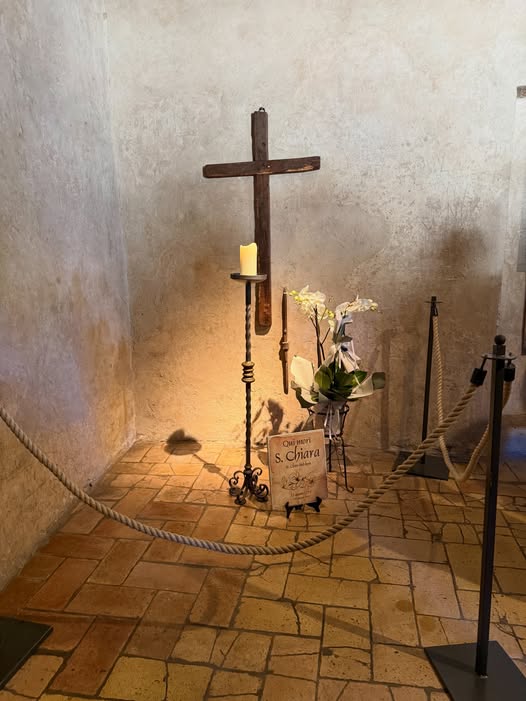
St. Clare, having joined herself to St Francis’ Christian mission of ‘pax et bonum’ – peace and goodness – lived her whole life in serious privation. She slept on the bare ground or on bundles of twigs in an austere convent that she never left. She rejected all chances of material gain, always striving to live an ideal life according to Jesus’ way. Happy indeed are the poor in spirit, liberated from the snares of this world. She and her sisters relied on the charity of others. A painful Illness in her later years she endured with grace and humility.
Clare’s ‘rule’ of life, still observed today by the Poor Clares and various associated communities of sisters, included that she own no property, relying completely on God’s guidance and providence. She thus accepted her vulnerability and patiently waited to enter eternal life as a trusting child of God.
But today, many are choosing not to wait. They are choosing to bypass suffering. Since commencing in Australia in 2019, over 7,000 deaths have been by assisted suicide and the rate has increased significantly in the last two years, whereby 3% of all deaths are now by this method. Most cases involve terminally ill patients who are in terrible pain and have been for some time. Often they have no hope of improvement and death is upon them. Furthering their anxiety and grief is the worry that their family will have to see, assist with, and endure this suffering. And this thinking is understandable.
Of course, well before one might even contemplate the option of permanently ending their time here on earth they, like most of us in this affluent nation, have lived their whole lives in ongoing comfort, availing themselves of all that which ameliorates suffering. Air-conditioning, pain relief medication, flu jabs, Uber Eats, and, perhaps less ubiquitously but more gravely, divorce and abortion. As a society, we are certainly not match fit for suffering.So when one is given the uber way to avoid severe pain and suffering, the decision to take it up is readily given consideration. We are used to trusting ourselves to set the pace of our existence. Suffering has become anathema to us and vulnerability has become a weakness.
Indeed, modern man insists on curating his own path, sweeping it as he goes of any detritus, clearing the way for a peaceful existence, removing any obstacles that lead to complications and heartache. Thus engaged, he is no longer practiced in coping with suffering. He cannot easily endure challenging commitments or trials such, for instance, as family relations inevitably bring. When life becomes difficult or unenjoyable, spouses are forsaken and new ones embraced. Parents and children are deposited in institutional care to alleviate the travails of the so-called sandwich generation, who are not willing or able (due to financial shackles) to play the role of loving filling. By the time old age comes along, he is totally unaccustomed to enduring suffering.
Ironically, our society now calls the assisted suicide path choosing a ‘good death,’ whereas the true meaning of this phrase used to lie within the Catholic church and actually meant that at your death, you were in a state of grace and ready to meet your maker at a time that He has already determined. But in our secular, post-Christian society, assisted dying has become a totally respectable – almost magnanimous – thing to do. There is no longer a Christian acceptance that our lives are not our own. There is no concession or submission to bodily vulnerability and suffering, let alone to God’s will. For modern man, suffering is something we can control and so to let it rule us is now shameful and humiliating. The ‘indignities of death’ are talked about as though any vulnerability or reliance on our fellow man is a weakness.
Indeed, man’s prideful nature has trouble submitting to a greater power, and the choice to kill oneself speaks directly to the atheist notion that there is no God and therefore no afterlife. What we have now, here on earth, is all. Therefore, we say, we should get to determine the best way to spend it. And why would we ‘choose’ to suffer if there is no point to it? Furthermore, it is a matter of pride. We do not want to lose control and be at the mercy of others. Society now posits that there is a lack of dignity in being unable to function independently and to be forced to rely on the care of others. But this is untrue. The dignity is provided by the love and care of those very caregivers: their humble service transmits it to the dying.
Far from being undignified, suffering is a necessary part of transforming us into people ready to meet God. Saint Faustina is famous for saying “if the angels were capable of envy, they would envy of us two things: one is receiving Holy Communion and the other is suffering.” For in suffering, we are able to offer love through sacrifice, and this can be meritorious. Who is to say that during those last few months of agony we aren’t transformed into saints? For certainly it is through trials that we are strengthened and forged. And doesn’t God know what we need and what circumstances will turn us to Him?
Or maybe it’s a family member who needs to see us suffering. They may be transformed by what they are forced to endure in caring for us. It may be the one truly selfless and noble thing they do in their life. Alleviated of this duty, our family members miss a potentially salvific opportunity. It is surely also morally wrong to deny ourselves and our family the full gamut of a human life. You don’t want your children to see you suffering? That is not realistic and is shielding them, perhaps to their spiritual detriment, from the truth of life and death.
End Thought: The miseries and indignities of the last years of life hold meaning and should be valued. They are not, as one healthy 90 years old who availed himself of an assisted suicide procedure said, superfluous.


Comments are closed.